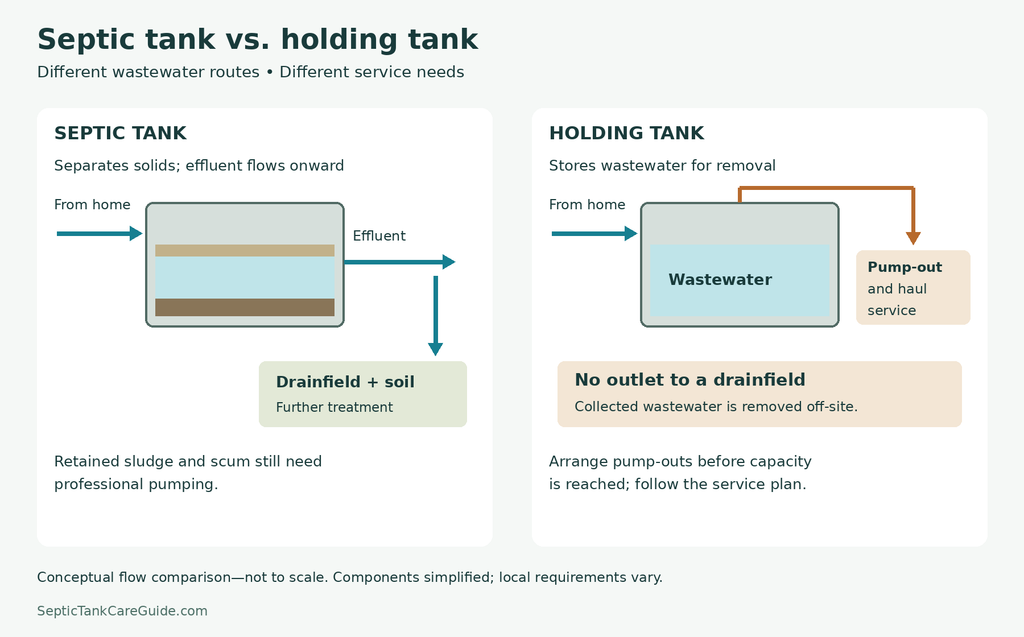
The main difference between a septic tank and a holding tank is where the wastewater goes next.
A septic tank separates solids and partially treats wastewater before liquid moves onward through the treatment and dispersal system. A holding tank stores wastewater for removal by a pumping contractor and transport to an appropriate treatment facility.
That difference changes how you plan servicing and household water use. Do not apply a conventional septic pumping schedule to a holding tank.
Affiliate disclosure: This article contains affiliate links. If you purchase through these links, we may earn a commission at no extra cost to you.
Researching septic treatments? View Septifix product information. Do not assume a product marketed for septic tanks is suitable for a holding tank.
How a Septic Tank Works
In a conventional septic system, wastewater enters the tank, solids settle, and lighter material floats. Liquid effluent leaves for further treatment and dispersal through the drainfield.
The tank retains material that requires periodic removal. It is one component of the system, rather than the complete treatment process.
Alternative installations may include additional equipment or different dispersal arrangements. See our guide to septic system types for an overview.
How a Holding Tank Works
A holding tank is a watertight storage container without an outlet to a drainfield. Wastewater collected in it must be pumped out and transported off site for treatment.
Its service needs depend on storage capacity and the wastewater entering it. Regular access for the pumping contractor is therefore important.
Confirm which household drains connect to the tank. Do not assume the arrangement from the tank’s appearance or a casual description in a property listing.
Comparison at a Glance
| Feature | Septic tank in a treatment system | Holding tank |
|---|---|---|
| Main role | Separation and partial treatment | Temporary storage |
| Normal wastewater route | Liquid moves onward for treatment and dispersal | Collected wastewater is hauled away |
| Pumping purpose | Remove accumulated contents, particularly solids | Remove stored wastewater |
| Service planning | Based on system condition and maintenance requirements | Based on filling, monitoring, and collection arrangements |
| Question to resolve | What treatment and dispersal components follow the tank? | What drains enter it, and how is collection scheduled? |
Why Pumping Schedules Differ
A holding tank needs a collection plan that prevents it from reaching an unsafe level. Do not wait for wastewater to back up before arranging service.
Ask the provider to establish the appropriate monitoring and booking procedure for the installation.
For a septic tank, ask how inspection findings and solids measurements inform pumping recommendations. Our septic tank pumping-frequency guide addresses that separate situation.
Keep the type of service clearly identified in your records.
Questions to Ask About a Holding Tank
Before taking responsibility for a property, request answers to these questions:
- What is the documented tank capacity?
- Which fixtures discharge into it?
- How is the level monitored?
- What does the alarm indicate?
- When should collection be booked?
- How much notice does the contractor require?
- Who provides backup service if the regular company is unavailable?
- What access must remain available?
Ask for the operating instructions in writing. Follow local requirements rather than adopting a schedule from another property.
An Alarm Needs a Clear Response Plan
If the tank has a warning system, ask the provider to explain its purpose and the action required when it activates.
Do not assume silencing a buzzer creates additional storage capacity. Do not open the tank to check the level yourself.
Keep the service number beside the operating instructions, and make sure other occupants know whom to contact.
Our septic alarm guide explains useful information to report, but the response must match your actual installation.
Comparing treatment claims? See Septifix’s product details. An additive cannot create a lawful wastewater outlet or eliminate the need to empty a holding tank.
Compare Ownership Costs Using Actual Records
Ask for previous collection invoices and service logs rather than relying only on an estimated annual cost.
A useful comparison includes:
| Cost question | Information to request |
|---|---|
| Routine collection | Price, included volume, and booking terms |
| Additional charges | Travel, difficult access, emergency visits, or other fees |
| Inspection | Scope and frequency |
| Equipment servicing | Alarm or other component maintenance |
| Usage assumptions | Occupancy and water use behind the estimate |
| Access work | Any improvements needed for reliable service |
For a seasonal property, explain both quiet periods and peak occupancy. A budget based on occasional use may not represent full-time living.
See our vacation-home septic care guide for questions about seasonal operation.
Confirm What You Are Buying
Before purchasing a property described as having a “septic tank,” verify the arrangement through records and professional assessment.
Ask for:
- The approved system description.
- Installation and modification records.
- Recent inspection reports.
- Pumping or collection history.
- Operating restrictions and service agreements.
- Outstanding recommendations.
Do not assume a holding tank can simply be converted into a septic system. Discuss any proposed change with a qualified designer and the local permitting authority.
Our homebuyer septic checklist provides further questions.
Keep Records That Match the System
For each visit, record the service date, provider, work completed, findings, and next action. For holding-tank collection, also retain any documented volume removed.
Use accurate labels such as “holding-tank collection” or “septic-tank pumping.” This helps a future provider understand the history.
Our maintenance-records guide includes a copyable log.
Frequently Asked Questions
Is a holding tank the same as a pump chamber?
No. A pump chamber moves wastewater onward within a system. A holding tank stores wastewater for off-site removal. Confirm the function of each component.
Does a holding tank treat wastewater adequately for discharge?
It is a storage arrangement, not permission to discharge wastewater. Contents require appropriate removal and treatment.
Can I drain a holding tank onto the property?
Do not release its contents onto the ground or improvise an outlet. Arrange collection by a qualified provider.
Does a septic tank normally contain liquid?
Yes. That alone does not establish a malfunction. Read septic tank full of water for the distinction between normal liquid storage and abnormal levels.
Can Septifix replace holding-tank pumping?
No. A product cannot remove the stored wastewater volume. Check compatibility before using any product, and maintain the required collection arrangements.
For separate product research, view Septifix here or read our research-based Septifix review.
Resources
This article provides general homeowner information. Holding-tank approvals and operating requirements vary by location.